EEGEmoLib
A plug-and-play EEG toolkit that includes modules for EEG-based emotion analysis.
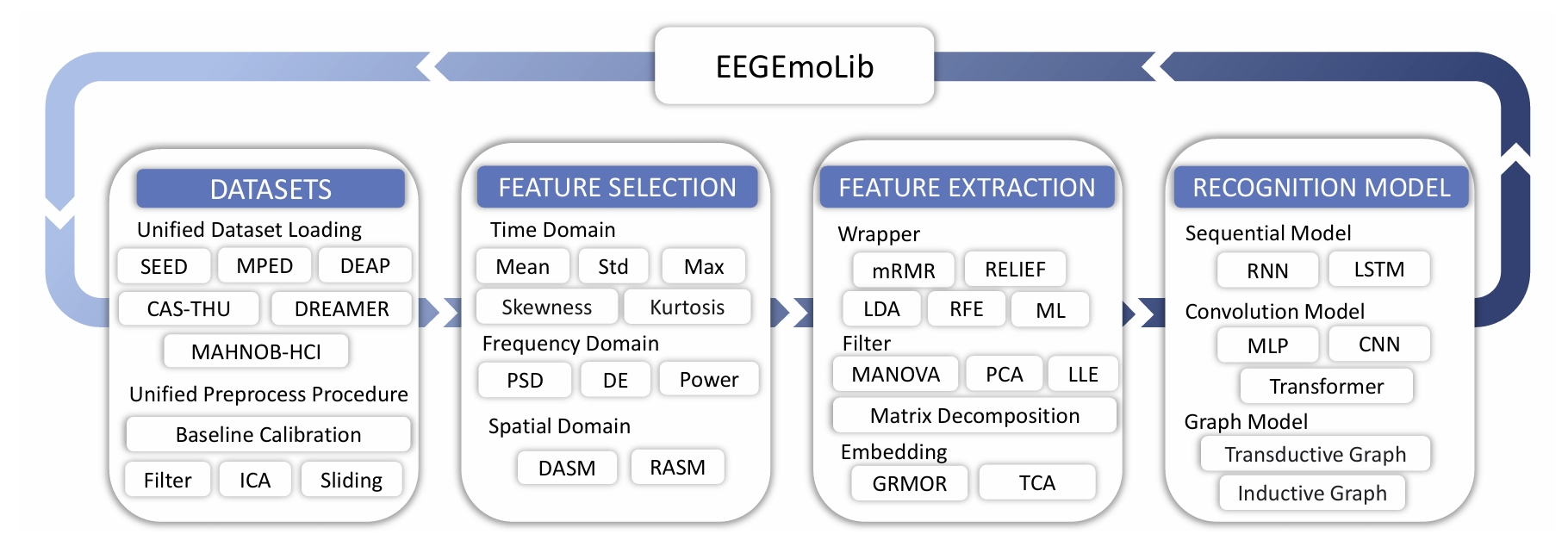
EEGEmoLib covers the major modules required for EEG emotion recognition workflows. The documentation website contains detailed usage instructions, dataset-specific setup, and implementation references, while the PyPI page provides package distribution and release information.
EEGEmoLib implements mainstream open source datasets. We use a single yaml file to set up the data loading from the dataset. Parameters such as the path, preprocessing procedure, split setting are all included in the yaml file.
Learn MoreEEGEmoLib implements 17 most commonly used handcrafted features: mean, variance, skewness, peak-to-peak (pp), first-order difference, second-order difference, normalized first-order difference, normalized second-order difference, energy, power, HOC, nonlinear signal indicator (NSI), Hjorth parameters, DE, PSD, coherence, and Hilbert-Huang spectrum.
Learn MoreEEGEmoLib implements 11 feature extraction methods within filter, wrapper and embedding. They include Univariate ANOVA, chi-square distribution, Principal Component Analysis (PCA), Kernel PCA, Non-negative Matrix Factorization (NMF), Locally Linear Embedding (LLE), Minimum-redundancy maximum relevance(mRMR), Linear Discriminant Analysis (LDA), Recursive feature elimination (RFE), SVM based wrapper and L1 regularization.
Learn MoreEEGEmoLib integrates 15 representative EEG emotion recognition methods (detailed in Table 5), spanning sequential, convolutional, and graph-based models. This collection includes both foundational and state-of-the-art approaches for EEG-ER. These implementations follow a structured organization within the models directory, with a clear categorization based on the input data dimensionality.
Learn MoreEEGEmoLib provides comprehensive visualization utilities for exploring EEG data and model behavior. Users can visualize raw EEG signals, feature distributions, and emotional state embeddings through plots. These tools facilitate intuitive understanding, debugging, and interpretation of EEG-based emotion recognition models.
Learn MoreThis page is the quick visual introduction to EEGEmoLib, focusing on the overall workflow, main capabilities, and external entry points.
Back to topThe PyPI page is the official package distribution page, where users can find installation, release versions, and package metadata.
Open PyPIThe documentation page contains the detailed user guides, dataset pages, feature descriptions, and model-specific references that go beyond this homepage.
Open DocsInstall EEGEmoLib directly from PyPI. The PyPI page provides release details and package metadata, and the documentation website provides setup instructions and usage examples.
pip install eegemolib
EEGEmoLib is presented through three public-facing pages: this homepage for overview, the PyPI page for package distribution, and the documentation page for detailed technical guidance.